Do You Need an ALTA Survey? Here Is How to Know for Sure
If your lender or title company just asked you for an ALTA survey and you are not sure what that means, you are not alone. Most people have never heard of one until it shows up as a requirement in a deal.
What an ALTA Survey Actually Is
An ALTA survey is a land title survey that follows a single national standard set by the American Land Title Association and the National Society of Professional Surveyors. Unlike a standard boundary survey, which follows state-specific rules, an ALTA survey works the same way in every state. That consistency is exactly why lenders and title companies require it for commercial transactions. Everyone involved in the deal, regardless of where they are located, can read and rely on the same document.
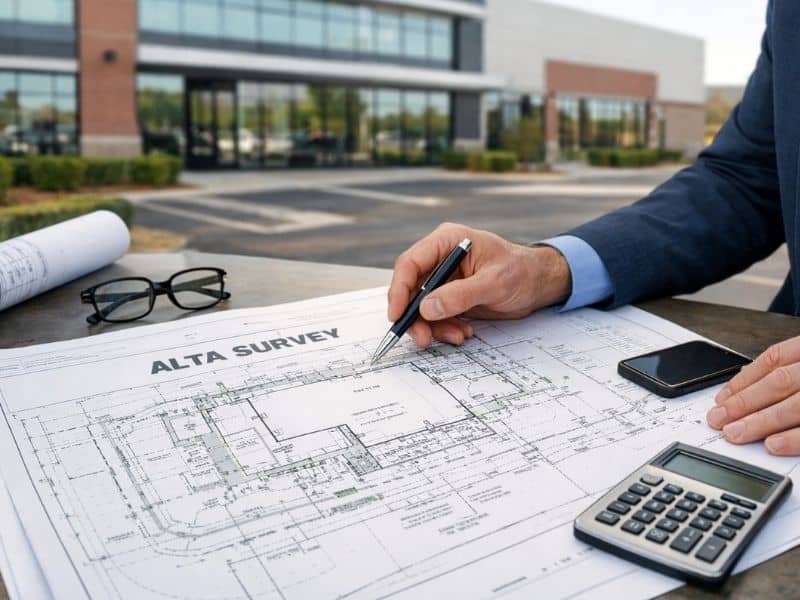
Beyond confirming property lines, an ALTA survey documents easements, rights-of-way, encroachments, existing structures, and how the property connects to a public road. These are the details that affect what a buyer can legally do with the land after closing.
The Situations Where You Will Almost Certainly Need One
An ALTA survey is not required for every real estate deal. But in the following situations, it is either required or strongly expected.
You Are Buying or Refinancing a Commercial Property
This is the most common situation. Title insurance companies and lenders routinely require an ALTA survey before a commercial property changes hands or gets refinanced. Office buildings, retail centers, warehouses, and mixed-use properties often have complicated easements, shared access points, and multiple structures on site. A standard survey would not document all of that to the level a lender needs.
You Are Purchasing Vacant Land for Development
Undeveloped land can look straightforward on paper but carry hidden problems. Many vacant parcels have never been surveyed, or the last survey was done decades ago using methods that are no longer accurate. An ALTA survey on raw land surfaces boundary conflicts, encroachment issues, and ownership questions before construction begins. Catching those problems before closing costs far less than discovering them after.
Your Lender or Title Company Is Based in Another State
Alabama has its own surveying standards, and a local boundary survey meets those standards just fine. But if your lender or title insurer is operating from another state, they may not know Alabama’s rules and may not be comfortable relying on a state-specific survey. An ALTA survey removes that concern because it follows the same national standard everywhere.
You Are Financing a Large Multi-Family Project
Most lenders treat apartment complexes and large multi-family developments the same way they treat commercial properties. An ALTA survey is commonly required as part of the financing process for these projects in Auburn and throughout Lee County.
You Are Dealing with a High-Value or Legally Complicated Residential Property
For most home purchases, a standard lot or boundary survey is all you need. The exception is when a property has an unusual legal description, involves multiple parcels, or is being converted from residential to commercial use. In those cases, a lender or title company may ask for an ALTA survey and will tell you when that is the case.
What the Survey Actually Covers
Every ALTA survey must meet the minimum requirements set by the American Land Title Association and the National Society of Professional Surveyors. The completed document will show:
- All property boundaries and their exact dimensions
- The location of buildings and other site improvements
- Easements and rights-of-way found in public records
- Any encroachments onto or from the property
- How and where the property accesses a public road
- The surveyor’s certification to all named parties
Understanding Table A Items
One thing that makes ALTA surveys different from other surveys is a section called Table A. This is a list of optional add-ons that a lender, title company, or buyer can request to expand what the survey covers. The current standards include 21 Table A items.
Some of the most commonly requested ones are:
- Flood zone classification and FEMA data
- Location of underground utilities
- Zoning classification and setback requirements
- Topographic contours and elevation data
- Parking count and configuration
- Wetlands identification
Each item adds to the cost. Simple items typically add $100 to $300. More detailed ones, such as a zoning compliance report or utility location, can add $500 to $2,000 or more. Confirm which Table A items are required before the survey begins. Adding items after work has started costs more than including them from the start.
How to Tell Which Survey You Actually Need
For a home purchase, fence placement, or boundary dispute, a standard boundary survey is the right choice. It is faster, less expensive, and meets Alabama state requirements for residential purposes.
For a commercial transaction, an out-of-state lender, a multi-family project, or vacant land being purchased for development, an ALTA survey is most likely required. Your attorney, lender, or title company will confirm which type they need. If you are unsure, ask them before ordering anything.
Frequently Asked Questions
What does ALTA stand for?
ALTA stands for the American Land Title Association. It works alongside the National Society of Professional Surveyors to set the national standards that all ALTA surveys must meet.
Is an ALTA survey required for a home purchase?
Not in most cases. Standard home purchases use a boundary or lot survey. An ALTA survey is only requested for residential property in unusual situations, such as a high-value purchase, a multi-parcel transaction, or when a title company requires extended coverage.
Who pays for the ALTA survey?
In most commercial deals, the buyer covers the cost as part of their due diligence. Some transactions split the cost between buyer and seller. Confirm this early with your attorney or title company.
Can a previous ALTA survey be reused?
Sometimes. If the survey is recent and nothing on the property has changed, a lender or title company may accept it with a re-certification from the original surveyor. If structures have been added, removed, or altered, a new survey is usually required.
